Why Custom Fiori Apps Break after S4/HANA upgrades and How CIOs Can Stop Paying It
Friday: Your Fiori apps work.
Monday after upgrade: Critical workflows fail, users can’t transact, and IT is firefighting. This isn’t an upgrade issue. It’s an architectural failure you’ve been carrying for years.
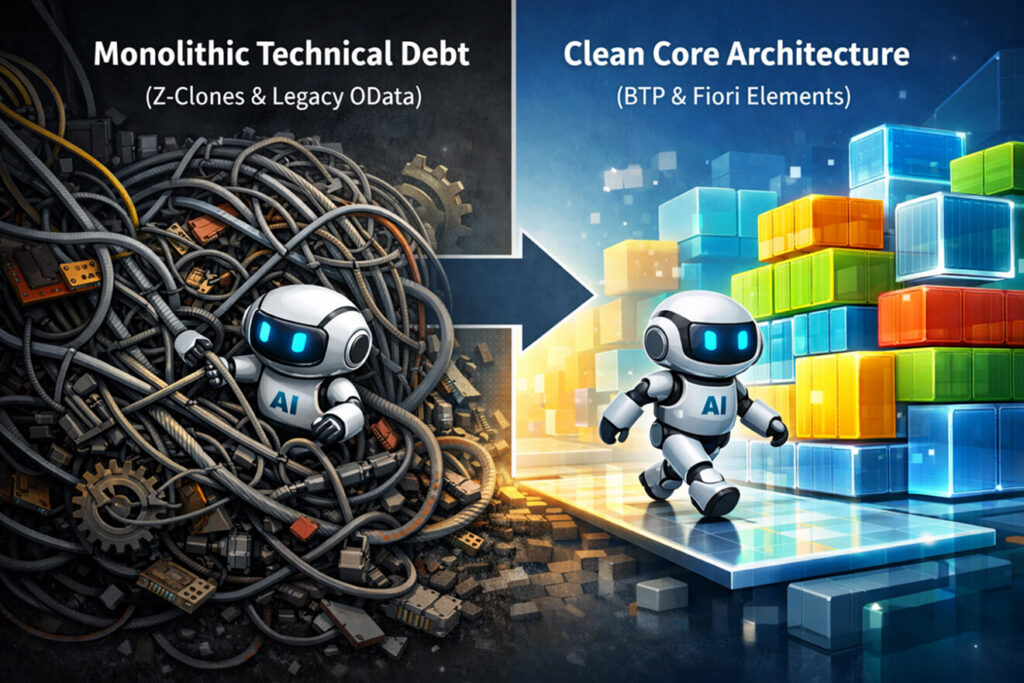
The root cause is rarely the upgrade itself. It is architectural debt, a hidden “upgrade tax” caused by technical shortcuts taken years earlier. In most cases, the break isn’t caused by SAP; it’s caused by years of Z-cloned apps, direct table reads, and UI logic built outside SAP’s supported frameworks.
For a CIO this isn’t just a development hurdle, it is a governance failure that erodes the ROI of the entire S/4HANA business case.
What Actually Changes (The Technical Shift)
Upgrading S/4HANA is no longer a simple database refresh. The move to the latest releases involves fundamental shifts in how SAP handles the UI:
- SAPUI5 Evolution: SAPUI5 is now updated continuously. If your apps depend on internal methods, every upgrade becomes a regression event—not a routine patch.
- The OData v4 Leap: SAP is pivoting from OData v2 to v4. Custom extensions built on legacy v2 services often require significant rework or total rewrites to maintain performance and compatibility.
- Clean Core Contracts: SAP has formalized Tier 1 Extensibility (C1 Contracts). Apps that bypass these “released” APIs are essentially reaching into the S/4HANA “basement”—accessing data through unreleased paths that SAP feels no obligation to keep stable.
The Invisible Cost: Technical Debt is an AI Tax
We are entering the era of the “Autonomous Enterprise,” where SAP Joule and Generative AI assistants navigate the ERP for the user. However, AI assistants rely on standard metadata and released APIs to understand business context.
If your Fiori landscape is a web of “Z-clones” and non-standard controllers, you aren’t just breaking your next upgrade—you are “blinding” your future AI. An AI assistant cannot effectively provide insights on a custom-cloned app that doesn’t follow the SAPUI5 standard.
CIO Perspective: Cleaning the core isn’t just about maintenance; it’s about AI-Readiness. Every app you bring back to “Standard” or “Fiori Elements” is an app that can immediately leverage SAP’s multi-billion-dollar investment in Business AI.
The Strategic Path: Extension Governance
Extensibility must be architecture-governed, not developer-driven.
1. The “Golden Path”: Fiori Elements
Freestyle UI5 offers flexibility but maximizes fragility. Fiori Elements should be the default for 80% of use cases. They follow SAP design templates and are automatically aligned with the SAP lifecycle.
Value: Standardization ensures your UI evolves with SAP, not against it.
2. Tiered Extensibility (Key User Tools First)
Before writing code, teams must exhaust Key User Extensibility (Custom Fields and UI Adaptation). These are “upgrade-proof” because SAP owns the compatibility layer.
3. Lifecycle Decoupling: Side-by-Side on SAP BTP
The S/4HANA core is your “System of Record”—it should be stable and governed. Your BTP extensions are your “Systems of Innovation”—they must be agile.
Value: By moving high-change apps to BTP, you ensure that a UI update in a customer portal doesn’t require a full regression test of your entire Finance core.
Embedded vs. Side-by-Side: The Decision Matrix
| Scenario | Strategic Choice | Lifecycle Speed |
| Minor field/UI addition | Embedded (Key User) | Fast / Immediate |
| Transactional extension | Embedded (Developer) | Moderate |
| Complex workflow/Integration | SAP BTP | Agility-focused |
| Innovation (AI/Analytics) | SAP BTP | High-speed / Decoupled |
A CIO Maturity Checklist: Are You Upgrade-Ready?
Before your next upgrade, assess your landscape maturity:
- The “Clone” Count: How many standard SAP apps were copied to the Z-namespace? (Each is a liability).
- API Health: What percentage of our custom code uses Tier 1 / Released APIs versus direct table access?
- Governance Gate: Do we have an Extension Review Board, or is the developer deciding where the code lives?
Modernization Gap: Are we spending more than 30% of our upgrade budget simply “fixing” what we already built?
The Strategic Message
The question for your leadership team is no longer: “Can we build this?” The question is: “Can we upgrade this safely in three years?”Clean Core is not about technical purity; it is a cost-containment strategy. Organizations that treat extension design as a strategic architectural decision will upgrade faster, innovate more safely, and stop paying the “upgrade tax” that stalls digital transformation.

About the Author
José López is a senior SAP technology leader with 20+ years of experience managing and optimizing mission-critical SAP environments. As Principal Director of SAP AMS, he leads end-to-end service delivery for large, complex SAP landscapes.
Contact Us
- Tell us more about your business and what you need from automation and business software.
- One Financial Center
16th Floor
Boston, MA 02111 - Request a Quote: +1 (833) 695-0811