The Case for Adopting Data Products. Proven Methods for Building Better BI, ML, and AI Solutions
Why Use Data Products
Data products aren’t mandatory for building BI dashboards, ML models or AI solutions, but they dramatically improve your odds of delivering successful, repeatable outcomes by adding semantic clarity and governance.
One Unified Intelligence Platform
In data and AI architecture, data products (trusted, reusable data assets with clear meaning, ownership, governance, and a defined way to be consumed) are the glue that makes the various architecture components operate as one unified intelligence platform.
Without data products, each tool in the architecture operates using its own interpretation of the data. With them, analytics, ML and AI share a consistent semantic foundation regardless of vendor stack. Consider how this plays out across two different ecosystems: An SAP-centric architecture and an AWS-native architecture.
SAP-Centric Architecture: SAP S/4HANA, Datasphere, Joule, and Databricks
- SAP S/4HANA generates operational data
- Datasphere models and governs it
- Joule and AI services consume it
- Databricks or similar platforms extend advanced analytics
All rely on shared, governed data products to maintain consistent business meaning.
AWS-Native Architecture: AWS S3, RedShift or Athena, SageMaker, and QuickSight
- Raw data lands in AWS S3
- The data is transformed through Redshift or Athena
- Then feeds both SageMaker models and QuickSight dashboards
Using data products ensures consistent definitions, governance, and reusable interfaces across analytics and AI workflows in this architecture.
Strong Predictors of AI Success
Organizations experimenting with AI can produce early results without structured data products. But when AI initiatives are measured by scalability, reliability, and enterprise adoption, a consistent pattern emerges: High-performing organizations treat governed data products as a foundational layer rather than an afterthought.
Data products act as strong predictors of success because they:
- Address a primary root cause of AI failure: Inconsistent semantics and unreliable data foundations.
- Emerge independently across high-maturity AI organizations, even when different technology stacks are used.
- Enable repeatability and governance, allowing models and analytics to move from experimentation to production.
- Support cross-domain AI, where insights and models span multiple business functions.
- Align with modern enterprise architectures, including SAP’s evolving data and AI strategy.
- Correlate with stronger business outcomes: Organizations adopting governed data layers consistently outperform those that rely on ad-hoc pipelines.
BI dashboards, ML models and AI solutions can be built without formal data products, but why would you want to? Organizations seeking scalable, reliable, enterprise-grade outcomes consistently find that data products are indispensable to achieving a successful outcome.
Organizational alignment matters as much as the technology
A second critical predictor of success is proactive engagement from the C-suite. Data has long driven strategic advantage in data-intensive industries such as Finance, Media, and Retail. But today data’s importance extends across every sector.
Executive sponsorship ensures that data products are treated as business assets, not just technical artifacts.
Technical and operational readiness must progress together
Adopting data products requires both of the following:
- Technical enablement: Platforms, architecture, and tooling
- Operational capability: Ownership models, governance processes, and data modeling skills
These dimensions are interdependent. Any delay in adopting either one can slow time-to-value. We recommend beginning with focused technical pilots that demonstrate clear business outcomes through small, easily understood implementations.
Early wins help build momentum, validate governance approaches, and create the organizational alignment needed to scale.
Understanding the Technical Platform
Let’s return to our SAP-centric and AWS-native examples introduced earlier for this discussion.

Spaces
In SAP Datasphere architecture, Spaces are the primary organizational construct used to structure and govern data products. Multiple Spaces enable both long-term data domain ownership and cross-domain collaboration, as well as temporary collaboration environments.
Spaces are the most crucial construct for data products. Spaces provide for both long-term Data Domain and Cross Domain creation as well as shorter-term collaboration spaces.
Create Spaces for different data domains like Customer Data, Product Data, Sales Data, Financial Planning & Analysis (FP&A), Social Data, Streaming Data, Financial Data, HR Data, and Manufacturing Data.
Enable data sharing and collaboration among these Spaces to encourage reuse (e.g., for an R&D project), while ensuring sensitive data is protected using methods like data masking and authorization. The PERMISSION Space authorization table, managed by designated security and administrative users, controls access rights for sharing data across these Spaces.
Architecture
The overall architecture to assemble and consume data products can be defined wholly within SAP Business Data Cloud. Alternatively, with a little (not a lot) more work, the architecture can be built with SAP Datasphere and Databricks tools – or with AWS cloud tools like S3, Redshift, Athena, and Quick Suite.
The architecture is typically organized into layered components:
- Inbound Layer: Capture or federate raw data from source systems and external platforms.
- Harmonization Layer: Standardize, transform, and clean data to ensure consistent structure and meaning across domains.
- Propagation Layer: Create unified consumption entities – such as analytic data products, semantic models, and reporting views – that can be reused across BI, ML, and AI scenarios.
- Reporting Layer: Optimize views specifically for reporting and analytics to support consistent branding, presentation, and user experience.
Governance
Effective data products require defined governance practices to ensure trust, consistency, and usability across domains. Establish clear ownership, naming conventions, and data lineage so users can understand and rely on the data they consume. Adopt a data catalog to manage data products and associated assets.
Roadmap
Adoption should follow a structured, value-driven roadmap aligned to business priorities and execution readiness. Create the roadmap based on business value, organizational priorities, and the ability to execute, typically a “crawl, walk, run” maturity approach.
Define initiatives by domain and cross-domain opportunities tied to clear business outcomes and supporting business cases. Select two to three visible data product opportunities that are achievable – not overly complex, but meaningful enough to demonstrate delivery and value.
Types of Data Products
Organizations typically work with two primary categories of data products:
- Certified data products provided or governed centrally.
- Custom data products built internally or through partners.
The following sections describe how these approaches apply within SAP Business Data Cloud (BDC) and broader data architectures.
Certified Data Products
Certified data products are governed, production-ready assets that follow standardized definitions, quality controls, and ownership models.
Data products arrive in SAP Business Data Cloud (BDC) in a basic form containing only the essential data for a business entity. Within SAP BDC, basic data products can be combined with other basic data products to form derived data products. These derived data products provide broader business context and are typically more useful for analytics and AI consumption.
Note: BDC is not mandatory to build your own or adopt preconfigured data products from SAP partners.
The following figure shows an SAP Business Data Cloud example of how source-level data products evolve into derived, consumer-oriented data products and higher-level business insights.
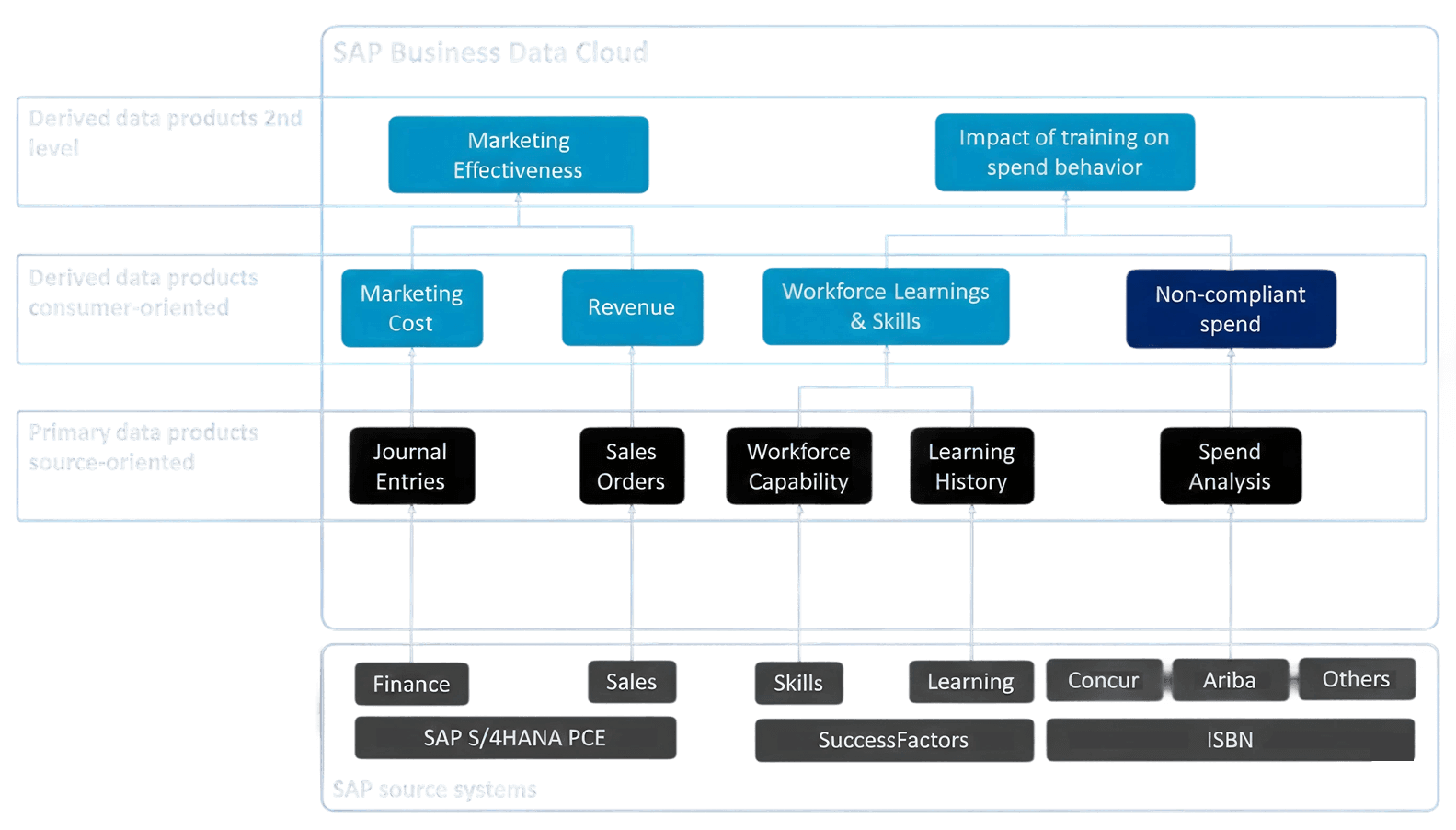
Source: SAP. Introducing Business Data Cloud. Focusing on Data Products and Intelligent Applications
Build Your Own
In addition to centrally certified data products, organizations may build their own commercial-grade or self-service data products tailored to specific business needs. These internally developed data products can still follow certified standards for governance, UX, and lifecycle management to ensure consistency and reuse across BI, ML, and AI initiatives.
For certified dashboards and commercial-grade data products, we recommend the following delivery lifecycle:
| Data Product Stage | Delivery Approach |
| Specification and Visual Design | Follow a standard specification template and define the consumption design for data structures and user interaction. |
| System Connection | Establish pipeline connections to new or existing source systems. |
| Ingestion Data Streams | Configure ingestion or federation at defined frequencies. |
| Transformation Base Data Products (unit test) | Structure, transform, and store foundational data tables. |
| User Experience Design (UX) | Design dashboard experiences with product UX expertise and SAP Analytics Cloud (SAC) specialization where applicable. |
| Consumption Dashboards (unit test) | Develop analytic views and dashboards (e.g., Athena views, QuickSight, or Power BI). |
| Product Validation (integration/acceptance test) | Validate transformations and consumption layers through integration testing and business acceptance. |
| Production and Validation | Use CI/CD pipelines to promote development assets to production and validate production readiness. |
| Beta | Release to a small test group for feedback and refinement. |
| GA Onboarding | Assign standard roles to consumers and validate access permissions. |
| Launch | Client Data Product Owner responsible for training, communication, and consumer support following the Product Launch Checklist. Apiphani will provide all the launch checklist items associated with development and support. |
Self service is a development that now brings organizations foundational value from data products. Using existing BI dashboards and Spaces as a starting poinit, self-service users can now rapidly bring new BI dashboards and Spaces into use with organized, certified data already available.
Data Product Marketplaces
Data product marketplaces provide curated assets that accelerate adoption by offering preconfigured datasets, models, and analytics aligned to specific business domains.
SAP: Available within SAP Business Data Cloud (BDC) via the SAP Business Accelerator Hub. These offerings include curated datasets, integration components, and analytical applications designed to support data-driven decision-making.
See: Data Product | Data Products | SAP Business Accelerator Hub
Apiphani: Available with or without SAP BDC. Organizations can select from an Apiphani catalog of preconfigured agents and KPIs spanning energy and manufacturing domains such as Finance, Engineering, Supply & Demand, Sales, and HR.
Implementation and Operational Considerations
Moving from data product concepts to real-world adoption requires a combination of governance practices, technical design decisions, and operating model alignment. The following considerations focus on how organizations evaluate potential data products, enable controlled self-service, and make architecture choices that balance agility with consistency.
These practices are not tied to a single platform; they apply across SAP Business Data Cloud, AWS-native environments, and hybrid architectures. Establishing clear evaluation criteria, access models, and data integration patterns helps ensure that data products remain scalable, governed, and reusable as adoption grows.
Data Products Evaluation Template
Use a consistent framework to evaluate and prioritize candidate data products:
- Opportunity / Purpose
- Business Priorities (Specific ROI or enabling priorities and strategies)
- Core BI and AI Value (qualitative, quantitative, and strategic impact)
- Technology and Data Availability
- Deployable / Time to Value
Self-Service Data Access
Implement self-service capabilities that allow business users to explore and model data independently while relying on governed data products as a foundation. This reduces reliance on centralized IT and increases agility without compromising consistency.
User Groups and Permissions
Define user groups and reusable roles to enforce appropriate access and authorization. Clearly structured roles help manage who can view, modify, or share data products across domains.
Remote Tables vs. Data Replication
Determine whether to use remote tables for real-time access without duplication, or replicated data for improved performance. Remote tables support immediate updates, while replication is better suited for performance-critical analytics.
CDS Views
When creating remote tables, we prefer using Core Data Services (CDS) views over direct S/4 tables to enhance performance and maintainability.
Operating Model
Successfully adopting data products requires more than architecture and tooling. It requires an operating model that aligns business leadership, governance structures, and technical delivery. Organizations that scale BI, ML, and AI initiatives treat data products as long-lived assets supported by clear ownership, domain leadership, and enterprise coordination.
The following roles and practices outline how operating models evolve to sustain governed, reusable data products across SAP Business Data Cloud, AWS-native, and hybrid environments.
Domain Leadership
Data domain strategy should align directly with business priorities and execution. Business leaders manage domains of defined size and scope, ensuring accountability for outcomes and data quality. While data products may integrate multiple domains, each data product should have a primary domain responsible for definition and implementation.
Data Product Owners guide success through key lifecycle phases — Concept, Business Planning, Development, Launch, and Support — shifting organizations from traditional project delivery toward a product-based operating model.
Data Product Ownership
A Data Product Owner is a business-savvy, technically aware steward responsible for ensuring that each data product remains accurate, governed, discoverable, and valuable for analytics and AI use cases.
This role operates at the intersection of business, data engineering, and data science and is one of the most important roles in a modern SAP data architecture. Key responsibilities include:
- Promoting and communicating data product value
- Representing consumer needs and adoption priorities
- Owning business meaning, definitions, and semantic consistency
- Ensuring data quality and trust
- Coordinating with other Data Product Owners across domains
Center of Excellence
The Center of Excellence (CoE) provides enterprise-wide leadership across discovery, governance, innovation, and community engagement. The CoE partners with domain leaders and Data Product Owners to catalog and manage data assets, collaborates with IT infrastructure teams on permissions and standards, and maintains a shared forum for tools, patterns, and emerging use cases.
Data Catalog
IT and apiphani teams jointly maintain secure infrastructure operations, managing system requests, incidents, and ongoing platform optimization. A centralized data catalog supports discoverability, governance, and lifecycle management of data products.
Building effective data pipelines requires specialized expertise across architecture, engineering, DevOps, and consumption design. Successful implementation depends on strong integration practices, security alignment, and continuous performance monitoring across enterprise environments.
C-Suite Role
Executive sponsorship is essential to drive organizational alignment around data, analytics, and AI. The C-suite plays a critical role in shifting mindset and prioritizing data products as strategic assets.
Engage executive leadership early to establish visibility and alignment, and deepen involvement once initial pilot data products demonstrate measurable value.
Culture and Mindset Changes
Together with evolving ways of working across Domain Leaders, Data Product Owners, and the CoE, the C-Suite enables the shift toward a data-driven culture, with the following focus areas guiding the transition to a steady-state operating model..
- Executive teams recognize and expect data products as key drivers of business performance, consistently delivering above-benchmark results and exceptional outcomes in strategic initiatives.
- Market leaders leverage embedded data products throughout their products, customer interactions, and operations. These organizations consistently generate and implement new ideas to enhance existing data products and develop new ones, driving continuous innovation.
- Data Pipeline Acceleration begins to show how reusable solution components and reliable data transformations and data views turn into system and user consumption at increasing speed to value, i.e., the AWS Data Flywheel.
- Data Self Service enables comprehensive data access across the enterprise. The platform provides streamlined data discovery, enterprise-grade analytics, and automated business insights at scale powered by tools such as SAP Just Ask.
Conclusion
Data products provide the structure that allows BI, ML, and AI initiatives to move beyond experimentation into scalable, governed business capabilities. Whether implemented within SAP Business Data Cloud, AWS-native architectures, or hybrid environments, success depends on more than technology alone. It requires clear ownership, strong governance, and an operating model aligned to business outcomes.
Organizations that treat data as a product, supported by domain leadership and executive sponsorship, create a foundation for repeatable innovation, faster time to value, and sustained competitive advantage.
About the Authors

James Kendrick
Principal Director of Data and Analytics Products at apiphani.

Mario de Felipe
Global Director of SAP Technology and Innovation at apiphani.
Contact Us
- Tell us more about your business and what you need from automation and business software.
- One Financial Center
Suite 1640
Boston, MA 02111 - Request a Quote: +1 (833) 695-0811